

Introduction: Feeling Lost? Let’s Decode NDIS Goals Together
If you are reading this, you or someone you love has probably just entered the world of the National Disability Insurance Scheme (NDIS). Let’s be honest—it can feel overwhelming. You might have heard words like “planning meeting”, “supports”, and “budget”, but the one word that confuses everyone at first is “goals“.
You might be thinking, “I’m not an athlete. Why do I need a goal?”
Don’t worry. In the NDIS world, a “goal” is not about winning a gold medal. It is simply a dream for your daily life written down on paper. It is how you tell the NDIS, “This is the help I need to live a better life.”
In this beginner guide, we will walk you through everything step by step. We will use very simple English and real-life examples and share NDIS goals examples you can learn from.
By the end of this article, you will understand:
- What an NDIS goal actually is.
- Why goals are the key to getting funding.
- How to write your own goals (with templates).
- 10+ real examples of good (and bad) goals.
Let’s take a deep breath. You can do this.
Contents
- 1 Part 1: What Exactly Is an NDIS Goal? (No Jargon)
- 2 Part 2: Why Your NDIS Goals Must Be “SMART”
- 3 Part 3: The 6 Most Common Types of NDIS Goals (With Examples)
- 4 Part 4: Real-Life NDIS Goals Examples (Beginner-Friendly)
- 5 Part 5: How to Write Your NDIS Goals (Step-by-Step)
- 6 Part 6: Common Mistakes Beginners Make (And How to Fix Them)
- 7 Part 7: Linking Your Goals to NDIS Funding (The “How”)
- 8 Part 8: What Happens at Your NDIS Planning Meeting?
- 9 Part 9: Reviewing and Changing Your Goals
- 10 Part 10: Printable Template – My First NDIS Goals
- 11 Conclusion: You Are Ready for Your NDIS Journey
- 12 Frequently Asked Questions (FAQ)
- 12.1 1. What happens if I don’t achieve my NDIS goals?
- 12.2 2. Can I change my NDIS goals after my plan is approved?
- 12.3 3. How many goals should I put in my first NDIS plan?
- 12.4 4. Can I use the same goal example from this article?
- 12.5 5. Does the NDIS fund goals for holidays or travel?
- 12.6 6. What is the difference between a goal and an NDIS support?
- 12.7 7. My English is not good. Can I write goals in my language?
- 12.8 8. Where can I read the official NDIS rules about goals?
- 13 Next Steps: Start Understanding Your Options Today
Part 1: What Exactly Is an NDIS Goal? (No Jargon)
In simple terms, an NDIS goal is a statement about something you want to achieve, learn, or improve in your life.
The NDIS uses your goals to decide what funding (money) to put in your plan. Think of it like this:
- Without a goal: You ask for “$10,000 for a support worker.” The NDIS says, “Why?”
- With a goal: You say, “My goal is to shower safely every morning so I can go to work. ” To do this, I need a support worker for 1 hour each day.”
When you connect your request to a real-life goal, the NDIS understands why the money is needed.
Short-Term vs. Long-Term Goals
You will have two types of goals in your NDIS plan:
| Type of Goal | Time Frame | Example |
|---|---|---|
| Short Term | Achieve within 12 months | “I want to learn how to cook two simple meals.” |
| Long Term | Takes a few years | “I want to live in my own apartment with low support.” |
Beginner Tip: Focus on short-term goals for your first plan. Keep it simple. The NDIS wants to see progress.
Part 2: Why Your NDIS Goals Must Be “SMART”
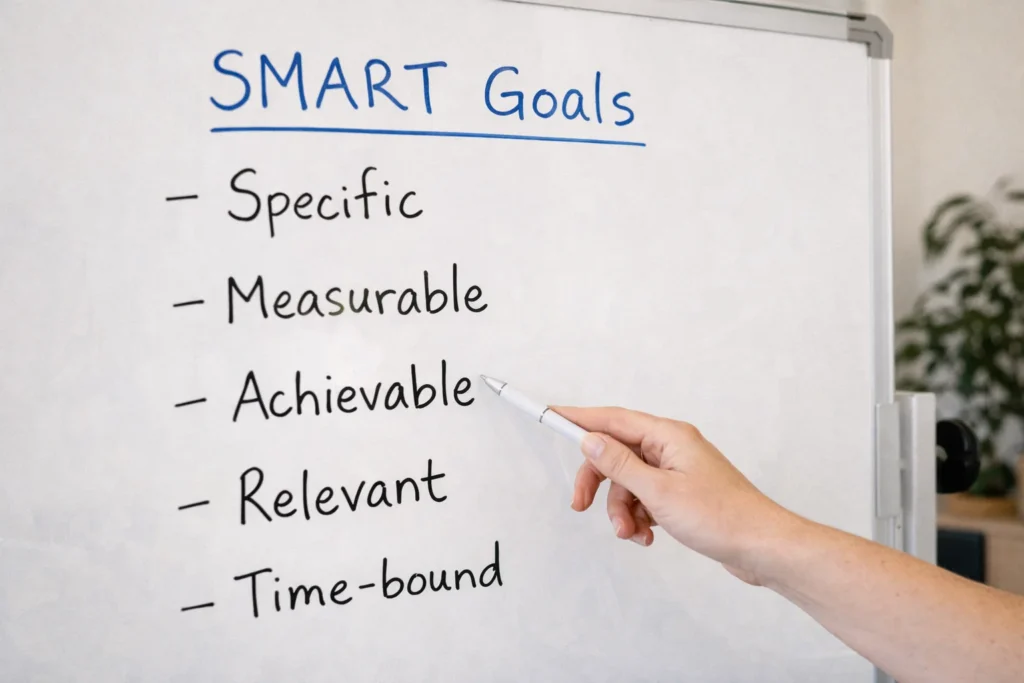
Not every goal works. If your goal is too vague, the NDIS might say no. To get funded, your goals should follow the SMART rule. This is a very famous method that even big companies use.
Here is what SMART means for your NDIS plan:
- S – Specific: Don’t say “I want to go out.” Say “I want to visit the local shopping centre once a week.”
- M – Measurable: How will you know you did it? (e.g., “I will be able to push my own wheelchair for 200 metres. ”)
- A – Achievable: Is it realistic? (Don’t say, “I want to fly. ” Say, “I want to use the bus by myself.”
- R – Relevant: Does this goal matter to you? (Not what your mum wants, but what you want.)
- T – Time-bound: When will you do it? (e.g., “In 6 months…”)
Part 3: The 6 Most Common Types of NDIS Goals (With Examples)
To make this easy, let’s look at the main areas of life the NDIS cares about. For each area, we will show you a Weak Goal (bad) and a Strong Goal (good).
1. Daily Living Goals (Personal Care)
This is about getting dressed, showering, eating, and moving around the house.
- Weak Goal: “I need help to get ready.”
- Strong Goal: “I want to be able to shower and dress myself independently by 8:30 AM each morning to get to my day programme on time.”
2. Social & Community Goals (Going Out)
This is about seeing friends, going to the movies, or visiting the library.
- Weak Goal: “I want to go out more.”
- Strong Goal: “I want to attend my local art class every Tuesday for 10 weeks to improve my social connections and reduce my anxiety.”
3. Health & Wellbeing Goals
This is about exercise, therapy, or eating better.
- Weak Goal: “I want to be healthy.”
- Strong Goal: “I want to work with a physiotherapist for 30 minutes weekly to improve my leg strength so I can stand for 5 minutes to brush my teeth.”
4. Goals for Learning and Building Skills
This is about learning how to use an iPad, cook, or ride the bus.
- “I want to learn” is a weak goal.
- “I want to get a Certificate I in hospitality skills in the next year so I can feel more confident and ready for work.”
5. Getting a Job (Job Goals)
This is about volunteering or paid work.
- Weak Goal: “I want a job.”
- Strong Goal: “I want to volunteer at the local op shop for 3 hours per week to learn workplace routine and communication skills.”
6. Transport & Mobility Goals
This is about using a bus, train, or taxi or driving a modified car.
- Weak Goal: “I need a taxi.”
- Strong Goal: “I want to learn to use the accessible bus route from my home to the library within 6 months to travel independently.”
Part 4: Real-Life NDIS Goals Examples (Beginner-Friendly)
Let’s put all this together. Below is a table of real situations. You can use these NDIS goals examples as a template for your own plan.
| Your Situation | NDIS Goal Example (Copy or edit this) |
|---|---|
| You have anxiety leaving the house. | “My goal is to visit my local café for 20 minutes every Friday with my support worker to build my confidence in public spaces.” |
| You need help cleaning your room. | “My goal is to learn how to sort my laundry and wash my clothes by myself within 4 months, using visual prompts.” |
| You want to use a computer. | “My goal is to learn basic typing and video calling skills within 12 weeks so I can talk to my grandchildren on Zoom.” |
| You have trouble swallowing. | “My goal is to work with an occupational therapist to practise safe eating strategies, reducing choking risks during dinnertime.” |
| You are a parent with a disability. | “My goal is to safely lift my baby from the cot using hoist equipment so I can care for my child independently every morning.” |
| You want to join a gym. | “My goal is to attend a hydrotherapy pool session once a week to reduce my muscle pain and improve my sleep quality.” |
| You want to move out of home. | “My goal is to learn budgeting, shopping, and cleaning skills over 18 months so I can transition to a Supported Independent Living (SIL) home.” |
| You have challenging behaviours. | “My goal is to reduce my outbursts from 5 times a day to 2 times a day by learning breathing techniques with a behaviour support practitioner.” |
| You want a pet. | “My goal is to demonstrate I can feed and water my assistance dog every day for 3 months to maintain my animal’s health and my responsibility.” |
| You want to garden. | “My goal is to use a raised garden bed to grow tomatoes, focusing on upper body movement for 15 minutes daily.” |
Part 5: How to Write Your NDIS Goals (Step-by-Step)
Now it is your turn. You do not need fancy language. Just answer these three simple questions in your head:
- What do I want to do? (e.g., “Make dinner”)
- Where or when? (e.g., “In my kitchen, every night”)
- Why does it matter? (e.g., “So I don’t have to wait for my mum”)
Now, write it in one sentence:
“I want to [action] at [place/time] so that [benefit].”
Let’s practise.
- You say, ‘I want to brush my hair.’
- Add time: Every morning before breakfast.
- Add reason: So I feel confident when I look in the mirror.
- Final Goal: “I want to brush my own hair every morning before breakfast so I feel confident starting my day.”
Perfect! You just wrote an NDIS goal.

Part 6: Common Mistakes Beginners Make (And How to Fix Them)
The NDIS planning team sees thousands of plans. Here are the mistakes that get plans rejected or underfunded.
Mistake #1: Asking for a Service, Not a Goal
- Wrong: “I need 20 hours of support from a worker.”
- Right: “My goal is to access the community twice a week for shopping and medical appointments, which requires 20 hours of support.”
Mistake #2: Goals that are medical treatments
The NDIS does not pay for doctors, surgery, or medicine. That is Medicare.
- Wrong: “My goal is to cure my chronic pain.”
- Right: “My goal is to manage my chronic pain using physiotherapy so I can sit up for 1 hour to watch TV.”
Mistake #3: Goals for Other People
The NDIS funds your life, not your carer’s break.
- Wrong: “My goal is to give my mum a rest.”
- Right: “My goal is to use in-home respite support for 4 hours weekly to give my family a break, which maintains my home living arrangement.”
Mistake #4: Being Too Vague
- Wrong: “I want to be happy.”
- Right: “I want to attend a social bowling group once a month to increase my feelings of enjoyment and belonging.”
Part 7: Linking Your Goals to NDIS Funding (The “How”)
Once you have your goals, the NDIS gives you money in three different “buckets” (called Support Categories). You need to make sure your goal matches the right bucket.
| Support Category | What it pays for | Example Goal |
|---|---|---|
| Core Supports (Daily living) | Help with showering, cleaning, and getting out of bed. | “I want to safely transfer from my bed to my wheelchair each morning.” |
| Capacity Building (Skills) | Occupational therapy, speech therapy, driving lessons. | “I want to learn to use voice-activated software on my laptop for my university course.” |
| Capital Supports (Equipment) | Wheelchairs, hoists, vehicle modifications. | “I want to operate a powered wheelchair indoors to move freely around my kitchen.” |
Beginner Tip: You do not need to memorise this. Your planner will help. But remember: Goal first, then money.
Part 8: What Happens at Your NDIS Planning Meeting?
Many beginners are scared of the “planning meeting”. Please don’t be. It is just a chat.
Here is how to talk about your goals during the meeting:
- Bring your written goals (use the examples above).
- Use “I” statements. (“I struggle with… I want to achieve…”)
- Tell a story. Don’t just read the paper. Say, “Last week, I couldn’t make lunch because I was too tired. My goal is to make a sandwich every day so I can eat healthier.”
Example Dialogue:
- Planner: “What do you want to achieve this year?”
- You: “My main goal is social connection. Right now, I stay home alone. I want to go to the library book club on Thursdays. To do that, I need a support worker to drive me there.”
The planner writes down: “Goal: Participate in community book club weekly.” – Approved.

Part 9: Reviewing and Changing Your Goals
Life changes. Your NDIS goals can change too.
- You get a plan review usually every 12 months.
- If your situation changes (e.g., you move houses or get a job), you can ask for a change of situation review earlier.
Do not panic if you don’t achieve a goal. The NDIS wants to see effort. If you tried and failed, that is okay. You can put the goal in your next plan.
Questions to ask yourself every 6 months:
- Did I achieve my goal?
- Do I need more help?
- Has my dream changed?
Part 10: Printable Template – My First NDIS Goals
Here is a simple template. Copy this into a Word document or write it on paper.
My Name: ______
My main dream (long-term goal):
In 2 years, I want to…
My 3 short-term goals (for this year):
- Daily Life Goal:
Action: ________
When: ________
Why: ________ - Community Goal:
Action: ________
When: ________
Why: ________ - Skills Goal:
Action: ________
When: ________
Why: ________
Conclusion: You Are Ready for Your NDIS Journey
Learning about NDIS goals can feel like learning a new language. But remember: At the heart of every goal is simply you wanting to live a better life.
You don’t need to be perfect. You just need to be clear.
We have covered a lot today:
- ✅ What NDIS goals are (dreams on paper).
- ✅ How to use SMART language.
- ✅ 10+ real-world NDIS goal examples.
- ✅ How to talk to your planner.
You now have the tools to write a strong, funded NDIS plan. Take this article, grab a cup of tea, and write down three things you want to do next week. That is your starting point.
The NDIS is here to help you, not confuse you. Go step by step.
Frequently Asked Questions (FAQ)
Here are the most common questions beginners ask about NDIS goals. If you are feeling stuck, you are not alone. Read these simple answers to clear up your confusion.
1. What happens if I don’t achieve my NDIS goals?
Nothing bad happens. The NDIS understands that life is unpredictable. If you don’t achieve a goal, you simply talk about why at your next plan review. Maybe you needed more time, or your health changed. The NDIS wants to see effort and learning, not perfection. You can keep the same goal for another year or change it entirely.
2. Can I change my NDIS goals after my plan is approved?
Yes, but there is a process. If you have a small change, wait for your yearly review. If you have a big change (e.g., you had an accident, moved houses, or your support needs increased dramatically), you can request a “Change of Situation” review. Call the NDIS on 1800 800 110 to start this. Do not change your goals without telling them first.
3. How many goals should I put in my first NDIS plan?
Aim for 3 to 5 short-term goals. Do not write 20 goals. Beginners often try to ask for everything at once. This confuses the planner. Focus on the most important areas of your life: daily living, community access, and health/skills. You can add more goals next year.
4. Can I use the same goal example from this article?
Yes, but personalise it. The NDIS planners have seen thousands of plans. If you copy a goal word-for-word (e.g., “I want to visit my local café every Friday”), they will know. Change the day, the place, and the reason. Make it yours. For example: ” I want to visit the Seaside Bakery every Wednesday to buy a coffee because it makes me feel part of my town.”
5. Does the NDIS fund goals for holidays or travel?
Sometimes, but not for fun. The NDIS will fund travel training (learning to use airports) or specialised equipment for travel (e.g., a portable hoist). However, the NDIS does not pay for your plane ticket, hotel, or sightseeing. Those are your personal costs. You can set a goal like “I want to learn to pack my suitcase and navigate the local train station independently within 6 months.”
6. What is the difference between a goal and an NDIS support?
This confuses many people.
- A goal is the outcome (what you want to achieve).
- A support is the tool or person that helps you get there.
Example: Your goal is “I want to cook dinner.” Your support is “a support worker for 5 hours a week” or “a modified chopping board”. Always write the goal first, then ask for the support.
7. My English is not good. Can I write goals in my language?
Yes. The NDIS provides free interpreters. You can do your planning meeting in your preferred language. However, the official written plan will be in English. You can ask a family member, friend, or local area coordinator (LAC) to help you write the goals in simple English based on what you said.
8. Where can I read the official NDIS rules about goals?
For the legally accurate, government-sourced information about how the NDIS assesses “reasonable and necessary” goals, you should read the official NDIS website.
Next Steps: Start Understanding Your Options Today
Feeling more confident? Great. Your journey has just begun. To build your knowledge, we recommend reading these guides next:
- Read our guide on how to apply for NDIS – If you don’t have a plan yet.
- Learn about NDIS eligibility requirements – Check if you or your family member qualifies.
You’ve got this. Welcome to NDISInsider.com, where we make the complex simple.
![A wide shot of a diverse group of people with various disabilities laughing together in a sunny Australian park. One person is using a walker. Everyone looks happy and connected.]](https://ndisinsider.com/wp-content/uploads/2026/04/5-1-1024x683.webp)