

Have you been looking for a job that feels meaningful? Maybe you are someone who loves helping others, or perhaps you have a family member living with a disability, and you want to understand how the system works.
You might be a little confused if you are reading this. It can be hard to understand words like “NDIS”, “participants”, and “support plans.” You might be asking yourself, “What does a support worker do?” Do I need to go to school? If you are reading this, you might feel a little confused. Words like “NDIS”, “participants”, and “support plans” can sound overwhelming. You might be wondering, ‘What does a support worker actually do?’ Do I need a degree? How do I get paid?
Take a deep breath. You are in the right place.
This tutorial will show you step by step how to become a disability support worker in Australia. We will explain everything in plain English, from what the NDIS (National Disability Insurance Scheme) is to how to obtain a job. You will have a clear plan for starting a profession that will transform lives, including your own, by the conclusion.

Contents
- 1 What is the NDIS? (And Why Does It Matter for Support Workers?)
- 2 Do You Have the Right Qualities to Be a Support Worker?
- 3 How to Become a Disability Support Worker: Step-by-Step
- 4 Understanding NDIS Funding: How Support Workers Get Paid
- 5 Types of Disability Support Work
- 6 What Does a Typical Day Look Like?
- 7 Challenges of Being a Support Worker (Be Honest)
- 8 How to Stand Out as a Support Worker
- 9 Frequently Asked Questions (FAQ)
- 10 Conclusion: Your First Step Towards a Rewarding Career
- 11 Image Prompts
What is the NDIS? (And Why Does It Matter for Support Workers?)
Before we talk about the job, we need to understand the system. In Australia, the NDIS (National Disability Insurance Scheme) is the way the government funds support for people with permanent and significant disabilities.
Think of it like this: Before the NDIS, getting help was often difficult and confusing. Now, eligible people—called participants—are given a budget. They use this budget to pay for the support they need to live a good life.
Who is a support worker?
A disability support worker is the person on the ground helping the participant. You are the one who turns the budget into real-life help. You might help someone get out of bed, go grocery shopping, attend a medical appointment, or simply have a coffee and a chat.
You are not just a worker; you are a vital part of someone’s ability to live independently.
Self-Managed vs Plan-Managed NDIS (7 Key Differences You Must Know)
The Role of a Support Worker in Daily Life

To make this clearer, let’s look at a real-life example.
Meet Sarah and her support worker, Tom.
Sarah is 28 years old. She has a physical disability that makes it hard for her to drive and do heavy cleaning. She lives in her own apartment in Melbourne.
- Tom arrives at 9:00 AM. He helps Sarah transfer from her bed to her wheelchair safely.
- Morning support: Tom helps prepare breakfast and does the dishes.
- Community access: Tom drives Sarah to her physiotherapy appointment and then to the local library.
- Afternoon: Tom helps with some light laundry before finishing his shift.
Tom doesn’t “do everything for Sarah”. Instead, he empowers her. He supports her living the life she wants, in her own home.
This is the heart of disability support: providing care with dignity.
How to Choose an NDIS Provider – 7 Simple Steps for Beginners
Do You Have the Right Qualities to Be a Support Worker?
Before we look at qualifications, let’s look at personality. You can learn the skills, but the right attitude is essential.
Great support workers usually have these qualities:
- Empathy: You can understand how someone else feels and treat them with kindness.
- Patience: Not every day goes to plan. You need to stay calm and flexible.
- Reliability: Participants rely on you. Showing up on time is crucial.
- Respect: You respect the participant’s home, choices, and privacy.
- Physical capability: Depending on the client, you might need to stand for long periods or assist with lifting.
If you already have these qualities, you are off to a great start.
How to Become a Disability Support Worker: Step-by-Step
Now, let’s get into the practical steps. The path to becoming a support worker is straightforward. Here is how to do it.
Step 1: Meet the Basic Eligibility Requirements
To work in disability support in Australia, you must meet a few basic checks. These are non-negotiable for your safety and the safety of participants.
| Requirement | Why It’s Needed |
|---|---|
| NDIS Worker Screening Check | This is a national background check. It ensures you are safe to work with vulnerable people. You cannot work with NDIS participants without this. |
| Working with Children Check | Even if you work with adults, you may be around children in the community. This is often required. |
| Proof of Work Rights | You need an Australian passport, birth certificate, or visa showing you are allowed to work in Australia. |
| First Aid & CPR | You must know how to respond in an emergency. This certificate needs to be updated every 1–3 years. |
Step 2: Get the Right Qualifications (Certificate III in Individual Support)
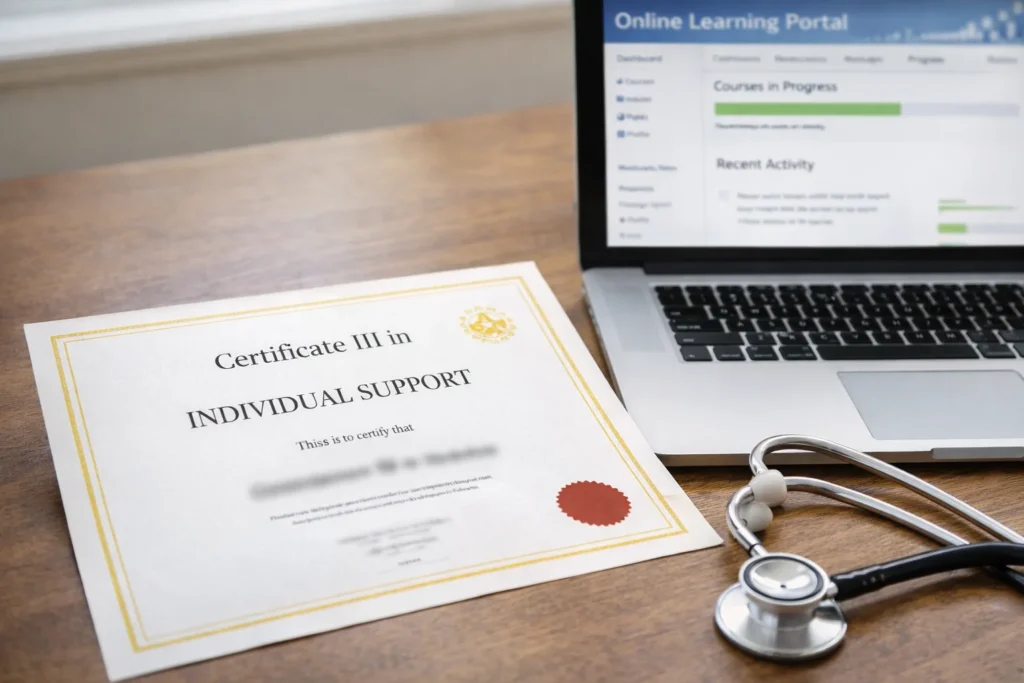
While life experience is valuable, most employers in Australia require a formal qualification. The standard entry-level qualification is the Certificate III in Individual Support (Disability).
What is it?
This course teaches you the basics. You will learn about:
- How to support people with different types of disabilities.
- Manual handling (how to lift safely).
- How to follow a support plan.
- Communication skills.
- Legal and ethical responsibilities.
How long does it take?
Usually, it takes 6 to 12 months to complete. Many Registered Training Organisations (RTOs) offer it online with practical work placements.
Do I need a driver’s licence?
Most jobs require you to have a driver’s licence and your own reliable car. Participants often need transport to appointments or social events.
Step 3: Gain Practical Experience
Theory is great, but real life is different. Your course will usually include a work placement. This is where you work (for free) in a real disability setting.
This is your chance to:
- See if you actually enjoy the work.
- Learn from experienced workers.
- Get a reference for your résumé.
- Build confidence.
Step 4: Apply for Jobs
Once you have your certificate and your cheques, you can start applying. There are three main ways to work in this field:
- Work for an NDIS Provider (Agency): These are businesses that hire support workers and pair them with people who need help. For beginners, this is usually the safest way. You get regular hours, training, and help. Work for an NDIS Provider (Agency): These are companies that employ support workers and match them with participants. This is often the safest way for beginners. You get consistent hours, training, and support.
- Work for Yourself (Sole Trader): After you have some experience, you can start your own business and work directly with clients. You set your own prices, but you also have to pay your own taxes, get your own insurance, and find clients.
- Work for a Family: Some people hire workers directly, without going through an agency. You can look for these jobs on sites like Mable or Hireup.
Understanding NDIS Funding: How Support Workers Get Paid
When you work with NDIS participants, the payment comes from the participant’s NDIS budget. The NDIS splits funding into different categories. As a support worker, you need to know which category your work falls under.
Here is a simple breakdown:
| Funding Type | What It Covers | Example of Your Work |
|---|---|---|
| Core Supports | Help with daily life. This is the most common budget. | Assistance with showering, dressing, cleaning, cooking, or transport. |
| Capacity Building | Help to build skills and independence. | Taking a participant to the gym to build strength, or helping them learn to use public transport. |
| Capital Supports | Funding for equipment or home modifications. | Support workers rarely use this directly, but you might help a participant set up new equipment. |
When you work for an agency, they handle the billing for you. If you work independently, you will need to understand how to invoice participants or the NDIS using a system called the NDIS Price Guide.
What NDIS Does NOT Cover: 7 Things You Must Know (Beginner Guide 2026)
Types of Disability Support Work

Not all support worker jobs look the same. You can choose a niche that suits your personality and skills.
1. Personal Care
This involves intimate support. You help with showering, toileting, dressing, and grooming.
- Best for: People who are compassionate, gentle, and respectful of privacy.
2. Community Access
This is about getting out of the house. You drive participants to the shops, movies, parks, or medical appointments.
- Best for: Social people who love driving and being outdoors.
3. Domestic Assistance
This involves light housework, meal preparation, and laundry.
- Best for: People who are organised and take pride in a clean home.
4. High-Physical Support
This involves working with participants who have complex needs, such as spinal cord injuries or brain injuries. You may need to use hoists, manage catheters, or provide complex bowel care.
- Best for: People who are physically strong and willing to complete advanced training (like medication administration).
5. Supported Independent Living (SIL)
This is 24/7 care in a shared home. You work in a team of other support workers to help a group of participants live together.
- Best for: Team players who enjoy shift work (including nights and weekends).
What Does a Typical Day Look Like?
If you are still wondering if this career is for you, let’s look at a typical day. Every day is different, which is why many people love this job.
Scenario: Working with James
James is 45 and lives with an intellectual disability. He loves rugby and cooking.
- 7:00 AM: Arrive at James’s home. Help him with his morning routine (shower, shave, dressing).
- 8:00 AM: Prepare breakfast together. James likes to make his own toast, so you stand by for safety but let him do it.
- 9:30 AM: Take James to his day programme, where he does gardening. You drop him off.
- 12:00 PM: Lunch break.
- 2:00 PM: Pick James up. Go to the supermarket to buy ingredients for dinner.
- 3:30 PM: Back home. Help James follow a recipe to prepare a simple meal. This is about teaching skills, not just cooking.
- 5:00 PM: Write notes in the communication book about how the day went (e.g., “James had a great day and was very happy at gardening”).
- 5:30 PM: Finish shift.
Challenges of Being a Support Worker (Be Honest)
To be a great support worker, you need to know the reality. It’s not always easy. Here are the challenges you might face:
- Emotional Stress: You will build relationships with people who are struggling. Sometimes participants have bad days, or they experience loss. You need to be emotionally resilient.
- Physical Demands: If you are doing manual handling, it can be hard on your back. You must use proper lifting techniques.
- Inconsistent Hours: When you start, you might not get a full 38-hour week. You might work mornings for one client and evenings for another.
- Boundaries: You are in someone’s home. It can be hard to maintain a professional relationship when you are helping with such personal tasks.
But despite the challenges, many workers say the rewards far outweigh the difficulties. There is nothing quite like knowing you helped someone live a better day.
How to Stand Out as a Support Worker
The NDIS is growing, and there is a high demand for good workers. But how do you make sure you get the best jobs?
- Upskill: Don’t just stop at the Certificate III. Consider getting extra certificates like the following:
- Medication Administration
- Catheter Care
- Autism Spectrum Disorder (ASD) Training
- Mental Health First Aid
- Be Tech-Savvy: Learn to use NDIS software and apps. Many providers use apps for timesheets and communication.
- Communication is key: always read the support plan. Always communicate with the family. Write clear shift notes. Good communication makes you invaluable.
Frequently Asked Questions (FAQ)
Do I need a university degree?
No. You do not need a university degree. A Certificate III in Individual Support (Disability) is the standard entry-level qualification. Some people start with just the NDIS screening check and first aid, but most reputable agencies require the certificate.
Can I work as a support worker if I have a criminal record?
It depends on the offence. The NDIS Worker Screening Check looks at the severity and age of the offence. Minor offences from a long time ago may not disqualify you, but serious offences (especially violence or fraud) usually will.
How much do disability support workers get paid?
Pay rates are set by the SCHADS Award (Social, Community, Home Care and Disability Services Industry Award).
- Casual rates are usually higher than part-time rates.
- You get paid more for working evenings, weekends, and public holidays.
- As a beginner, you might start around $30–$35 per hour (casual), but this increases with experience and penalties.
Is this job only for women?
Not at all! There is a huge demand for male support workers. Many male participants prefer to have a male worker, especially for personal care or community access (like going to the football).
Can I become a support worker if English is my second language?
Yes! Australia is a diverse country. If you have good communication skills and can understand the safety requirements, your language skills are an asset. Many participants come from multicultural backgrounds and prefer workers who speak their language.
Conclusion: Your First Step Towards a Rewarding Career
Becoming a disability support worker is about more than just a job. It is about joining a community of people who believe that everyone deserves to live a life of dignity, choice, and independence.
The path is clear:
- Check your eligibility (NDIS check, first aid).
- Get your Certificate III in Individual Support.
- Complete your work placement for experience.
- Apply for jobs with NDIS providers.
- Keep learning and growing your skills.
If you are patient, kind, and ready to work hard, you will find this career incredibly fulfilling. You will meet amazing people, learn new skills every day, and go home knowing you made a real difference.
Ready to learn more?
Understanding the NDIS is the first step. If you want to get a better picture of how participants apply for funding, read our guide on how to apply for NDIS. You can also check out our article on NDIS eligibility requirements to understand who qualifies for support.
Start understanding your options today. The disability community needs caring people like you.
Image Prompts
[Insert Image Here – Introduction Hook]
Prompt:
“A realistic, professional photograph of a diverse group of smiling disability support workers and participants in a bright Australian park. One worker is pushing a wheelchair along a path; another is sitting on a bench chatting with an elderly participant. The lighting is warm and sunny, evoking feelings of community, trust, and support. High quality, photorealistic.”
[Insert Image Here – Certificate III Section]
Prompt:
“A close-up, realistic image of a Certificate III in Individual Support qualification displayed on a wooden desk in Australia. Next to the certificate is a laptop showing an online learning portal and a stethoscope. The scene is clean, professional, and educational. High quality.”
[Insert Image Here – Types of Support Work (Community Access)]
Prompt:
“A realistic scene of a male disability support worker in Australia helping a young man with a disability load groceries into the back of a car in a suburban shopping centre parking lot. Both are smiling and engaged in conversation. The car is a standard SUV. The atmosphere is casual and supportive. High-quality, candid shot.”
[Insert Image Here – Daily Life Example]
Prompt:
“A realistic, professional image inside a bright, clean Australian kitchen. A female disability support worker is standing next to a man in a wheelchair who is helping to chop vegetables on the counter. The focus is on collaboration and skill-building. Soft natural light coming from a window. High-quality, respectful representation.”