

Contents
- 1 Introduction
- 2 Part 1: Understanding the NDIS (Without the Confusion)
- 3 Part 2: How the NDIS Actually Works (The Money Flow)
- 4 Part 3: Should You Register with the NDIS?
- 5 Part 4: Step-by-Step Guide to Starting Your NDIS Business
- 6 Part 5: Common Beginner Mistakes to Avoid
- 7 Part 6: Real-Life Scenarios to Help You Understand
- 8 Part 7: Marketing Your NDIS Business (Without Spending a Fortune)
- 9 Part 8: The Future of Your Business
- 10 Conclusion: Your First Step
Introduction
Have you ever found yourself helping a neighbour with their shopping or spending time with a family member who needs extra support and thought, “I wish I could do this for a living”?
If you are reading this, you might feel a mix of excitement and confusion. You have heard about the National Disability Insurance Scheme (NDIS). You know it’s about helping people with disabilities, but the process of starting a business around it feels overwhelming.
You are not alone.
The NDIS is one of the most life-changing systems in Australia, but it can also be one of the most complex to navigate—especially if you are trying to build a business from scratch.
In this guide, we will strip away the jargon. We will explain exactly what the NDIS is, how it works for participants (the people who need support), and how you—a beginner—can start your own NDIS business. Whether you want to be a sole trader support worker or build a large service provider company, this guide will walk you through the basics step by step.
Part 1: Understanding the NDIS (Without the Confusion)
Before you can start a business, you need to understand what you are getting into. The NDIS is not just a “government programme”. It is a system that funds individuals.
What is the NDIS?
Think of the NDIS like a bank account for disability support. For eligible Australians with a permanent and significant disability, the NDIS provides funding to pay for the supports they need to live a normal life.
Imagine a young man named Jake. Jake has a spinal cord injury. Before the NDIS, his family struggled to pay for a wheelchair ramp and daily help. Now, the NDIS gives Jake a budget. He uses that budget to pay a support worker (maybe someone like you!) to help him get ready in the morning, go to the gym, and attend TAFE.
Key Point: The NDIS doesn’t provide the services directly (usually). It provides the money so participants can buy services from businesses like the one you want to start.
Who is the NDIS for?
The NDIS is designed for Australian citizens or permanent residents under the age of 65 who have a permanent disability that significantly impacts their daily life.
- Not just physical disabilities: the NDIS also supports people with intellectual disabilities, psychosocial disabilities (mental health), autism, and developmental delays.
- It’s about goals: the NDIS focuses on helping participants achieve their goals, whether that is finding a job, learning to cook, or making friends.
Part 2: How the NDIS Actually Works (The Money Flow)
To run a successful business, you need to know how you will get paid. In the NDIS world, money flows through different “funding categories”. Understanding these is crucial.
The Three Main Support Categories
When a participant gets their NDIS plan, their funding is split into three budgets. Here is a simple table to explain them:
| Budget Category | What It Covers | Example Service |
|---|---|---|
| Core Supports | Help with everyday life. This is the most common budget. | Assistance with daily life (showering, dressing), consumables (gloves, pads), and transport. |
| Capacity Building | Help to build skills and independence. | Support for employment, therapy (OT, speech), exercise physiology, and social skills groups. |
| Capital Supports | Higher-cost items and equipment. | Wheelchairs, vehicle modifications, assistive technology (special computers). |
For beginners: Most NDIS businesses start by offering Core Supports (specifically “Assistance with Daily Life”) or Capacity Building (like “Support Coordination” or “Therapy”).
How Do You Get Paid?
This is a critical part of learning how to start an NDIS business. You will get paid based on the NDIS Price Guide. The NDIS sets maximum prices that providers can charge for specific services. You do not have to charge the maximum, but you cannot charge more.
There are three ways participants pay you:
- NDIA Managed: The NDIA (National Disability Insurance Agency) pays you directly. You just send an invoice.
- Plan Managed: A “Plan Manager” (a finance expert) pays you on behalf of the participant.
- Self-Managed: The participant pays you, and then they claim the money back from the NDIS.
Real-Life Example:
Let’s say you are a support worker. You help a participant, Sarah, for 4 hours. The NDIS Price Guide allows you to charge $60 per hour (this is a simplified example). You send an invoice. Sarah’s plan manager pays you $240. You have just run a successful NDIS business transaction.
Part 3: Should You Register with the NDIS?
One of the biggest questions beginners ask is: Do I need to register my business with the NDIS Commission?
The answer is: it depends.
Option 1: Unregistered Provider
If you are an unregistered provider, you can only work with participants who are plan managed or self-managed. You cannot work with participants whose funding is “NDIA Managed”.
Pros:
- Cheaper and faster to start.
- Less paperwork and red tape.
- Great for sole traders testing the waters.
Cons:
- You miss out on a large portion of the market (NDIA-managed participants).
- You cannot offer certain high-risk services (like specialist disability accommodation or restrictive practices).
Option 2: Registered Provider
If you become a registered provider, you can work with any participant (NDIA managed, plan managed, or self-managed). However, you must follow strict rules, have insurance, and undergo audits.
Pros:
- Access to 100% of the market.
- Looks very professional; builds trust.
- Required for certain support types.
Cons:
- Expensive to register (audits cost thousands of dollars).
- Takes months to complete.
- High compliance burden.
Recommendation for Beginners:
If you are just one person looking to help a few people in your community, start as an unregistered provider. It is the easiest way to learn how to start an NDIS business. You can always register later as you grow.
Part 4: Step-by-Step Guide to Starting Your NDIS Business
Now that you understand the landscape, let’s get into the nitty-gritty. Here is a 7-step roadmap to turn your idea into a reality.
Step 1: Identify Your Niche (What Will You Do?)
The NDIS is huge. You cannot be everything to everyone. Trying to offer “everything” is the fastest way to burn out.
Ask yourself:
- Do I want to be a support worker (helping with daily tasks and community access)?
- Do I have a trade? (Gardening, cleaning, and handyman services are in high demand for NDIS participants).
- Do I have a therapy qualification? (OT, physio, speech, psychology).
- Do I love driving? (Transport services).
- Do I love numbers? (Support Coordination or Plan Management).
Example: Instead of saying “I help people with disability,” a successful niche is “I provide in-home gardening and lawn mowing for NDIS participants in Western Sydney who use wheelchairs.”
Step 2: Set Up Your Business Structure
You need to be a legitimate business. You cannot just start invoicing as “John”.
- Apply for an ABN (Australian Business Number): This is free and takes about 20 minutes on the Australian Business Register website.
- Choose a Business Structure:
- Sole Trader: Simplest. You are the business. Lower cost, but you are personally liable if something goes wrong.
- Company (Pty Ltd): More complex. Protects your personal assets but costs more to set up and maintain.
- Get Insurance: This is non-negotiable. You must have:
- Public Liability Insurance: Covers you if a participant trips over your bag and gets hurt.
- Professional Indemnity Insurance: Especially if you are giving advice or therapy.
- Workers’ Compensation: If you hire staff.
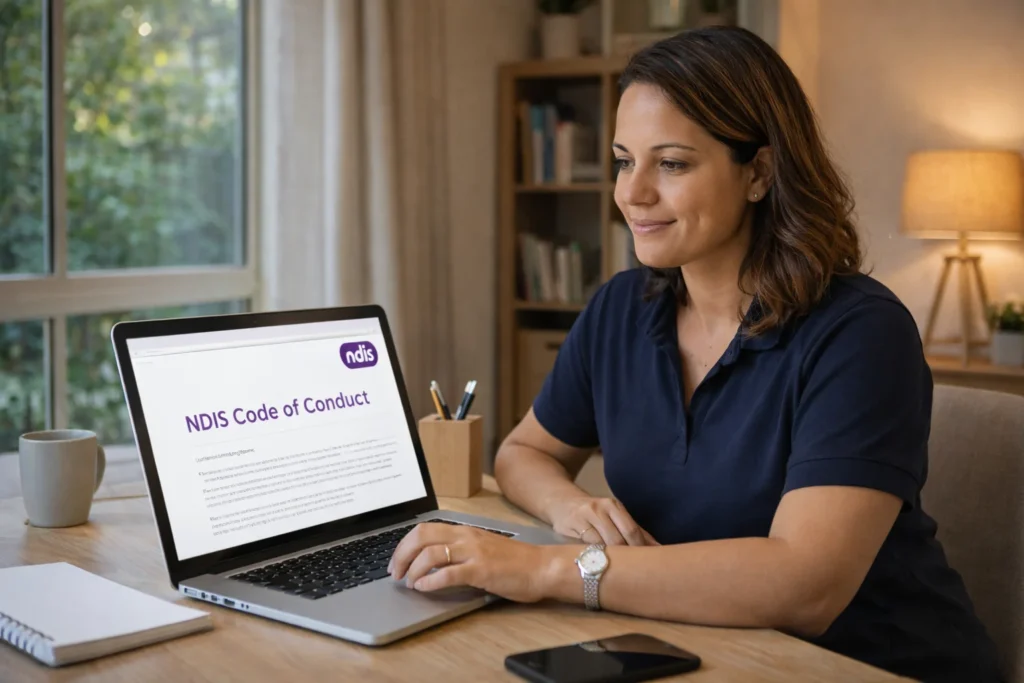
Step 3: Understand the NDIS Code of Conduct
The NDIS Commission has a strict Code of Conduct. It is a list of rules that all workers (registered or unregistered) must follow.
The main points are:
- Act with respect for the participant’s rights.
- Do not take advantage of the participant (financially, emotionally, or physically).
- Provide supports safely and competently.
- Report any suspected abuse or neglect.
If you are wondering how to ensure you are following the rules, you can read our guide on how to apply for NDIS to see the process from the participant’s side—understanding their rights helps you respect them.
Step 4: Develop Your Policies and Procedures
Even if you are unregistered, you should have a “Policy Manual”. This sounds boring, but it saves you from trouble later.
Your manual should include:
- Privacy Policy: How you handle participant information (this is a legal requirement under Australian Privacy Law).
- Complaints Policy: What happens if a participant is unhappy?
- Incident Management: What do you do if someone falls or there is a car accident?
- Worker Screening: You must have a valid NDIS Worker Screening Check. This is a background check to ensure you are safe to work with vulnerable people.
Step 5: Pricing Your Services
If you are unregistered, you can charge whatever you want (within reason), but participants will expect you to follow the NDIS Price Guide.
To find the current prices, search for the “NDIS Price Guide” online. It is updated every year.
- Weekday daytime hours are standard.
- Evenings, weekends, and public holidays have higher loading (extra pay).
- Travel: You can usually charge for travel if you are travelling between participants, but not for travel to your first participant of the day.
Pro Tip: Be clear about your cancellation policy. The NDIS allows you to charge 100% of the fee if a participant cancels with less than 7 days’ notice. This protects your income.
Step 6: Find Your First Participants
How do you get clients? This is often the hardest part.
- Networking: Contact local “Support Coordinators”. These are professionals who help participants manage their plans. If they like you, they will refer their clients to you. Be friendly, drop off a business card, and introduce yourself.
- Facebook Groups: Local community groups and NDIS groups are great places to introduce your services. Be helpful, not pushy.
- Local Area Coordinators (LACs): These are the NDIS partners in the community. They often know who needs support.
- Word of Mouth: If you do a good job, participants will tell their friends.
Step 7: Manage Your Finances
Running an NDIS business is running a real business. You need to keep track of:
- Invoicing: Use software like Xero, QuickBooks, or even a simple invoice template. Always include your ABN.
- Taxes: Set aside 20-30% of your income for tax and GST (if you earn over $75,000 a year, you must register for GST).
- Superannuation: If you hire staff, you must pay super. If you are a sole trader, you should pay your own super.
Part 5: Common Beginner Mistakes to Avoid
To help you succeed, let’s look at the pitfalls that trip up many new NDIS businesses.
1. Not Getting the NDIS Worker Screening Check
You cannot start working without this. If you try to work with participants without a valid check, you are breaking the law. It can take weeks to come through, so apply early.
2. Ignoring the “Informal Supports”
The NDIS does not fund supports that families or friends usually provide for free. If a participant lives with their parents, you cannot claim that you will “do the cooking” if the parents are there to do it. The NDIS looks for “value for money”.
3. Burnout
As a new provider, you might want to say “yes” to everyone. If you work 7 days a week, you will burn out fast. It is okay to have boundaries and take days off.
4. Misunderstanding Shift Work
Many new support workers think, “I’ll work 9 to 5. ” NDIS work is often early mornings (helping people get ready for school/work) and evenings (helping with dinner and bedtime). It can be unsociable hours, but the pay reflects that.
Part 6: Real-Life Scenarios to Help You Understand
Let’s paint a picture of what a typical day might look like for an NDIS business owner.
Scenario: The Sole Trader Support Worker
- Name: Maria
- Niche: Community access and daily living.
- Business Type: Unregistered Sole Trader.
Maria’s Monday:
- 7:00 AM: Arrives at James’s house. James is a 19-year-old with autism. Maria helps him with his morning routine (showering, dressing, and making breakfast). She drives him to his supported employment programme.
- 10:00 AM: Maria heads to the gym. She meets her client, David, who uses a wheelchair. She assists him with his exercise programme designed by a physiotherapist. This is capacity-building support.
- 12:00 PM: Lunch break. Maria uses this time to send invoices to her plan manager clients from last week.
- 1:00 PM: Maria visits a new participant, Linda, for a “handover”. Linda’s previous support worker is leaving. Maria learns about Linda’s routine, her cat, and her favourite TV shows.
- 3:00 PM: Maria picks up James from his programme. They go grocery shopping. Maria helps James count money and choose healthy food. This is building independence.
- 5:00 PM: Maria finishes her day. She notes in her daily log (important for invoicing) that she worked 8 hours total.
Why does this work?
Maria provides a needed service. She is reliable, friendly, and understands the NDIS rules. She uses a simple app to track her time and sends invoices every Friday. Her clients love her, and they refer her to their friends. She is successfully running an NDIS business.
Part 7: Marketing Your NDIS Business (Without Spending a Fortune)
You don’t need a fancy billboard to get clients. In the NDIS world, trust is the best marketing.
- Your Reputation: Be on time. That is rare in this industry, and it makes you stand out. If you are five minutes late, text the participant.
- Professionalism: Wear appropriate clothing (a polo shirt with your business name is great). Have a professional email address (not Hotmail4eva).
- Website: You need a simple website. It should explain who you are, what you do, and how to contact you. This builds credibility.
- Learn about the application process: many of your future clients will be going through the process of getting their plan approved. If you understand the system, you can be a huge help to them. Learn about NDIS eligibility requirements so you can answer their questions confidently.

Part 8: The Future of Your Business
Starting an NDIS business is not a “get rich quick” scheme. It is a career in human services. However, with the NDIS being a $40+ billion dollar scheme supporting over 600,000 Australians, there is massive demand.
If you want to grow beyond a sole trader:
- Hire staff: You can hire other support workers. You become the “provider”, and they work for you.
- Specialise: Become an expert in a niche area, like “Autism Support” or “High Intensity Medical Support” (if you have nursing qualifications).
- Go Registered: As mentioned earlier, registering opens doors to government contracts and agency-managed participants.
Conclusion: Your First Step
Starting an NDIS business might seem daunting. There are acronyms (NDIS, NDIA, LAC, SIL, SDA), there are rules, and there is a lot of paperwork.
But at its heart, the NDIS is simple: it’s about people helping people.
You don’t need to know everything today. You just need to take the first step.
- Decide what service you want to offer.
- Apply for your ABN and worker screening check.
- Talk to one participant or one support coordinator.
The NDIS community is full of people who want to see new providers succeed, because every new provider means more choice and more support for people with disability.
Take a deep breath. You have the compassion. Now you have the roadmap.
Ready to take the next step?
If you want to understand how the system works from the participant’s perspective to better serve your future clients, start understanding your options today by exploring our other beginner-friendly guides.
Frequently Asked Questions (FAQ)
Q: How much money can I make with an NDIS business?
A: It varies widely. A sole trader support worker earning $60–$70 per hour (excluding GST) can make a good living if they work 30-40 billable hours a week. Once you hire staff, your income potential scales up.
Q: Do I need a qualification to be a support worker?
A: Not legally for basic daily living support. However, having a Certificate III in Individual Support (Disability) makes you much more employable (or attractive to participants) and ensures you know how to provide safe care. For therapies (OT, speech), you need a university degree and registration with AHPRA.
Q: Can I work with family members under the NDIS?
A: Generally, no. The NDIS specifically does not fund support from family members who live with the participant or are considered “informal supports”. It is intended to fund external support to give families a break and provide professional care.
Q: How long does it take to get registered as a provider?
A: If you choose to register, expect the process to take 3–6 months from start to finish, including the audit. This is why many start as unregistered.
Disclaimer: This information is for educational and informational purposes only and does not constitute legal or financial advice. NDIS rules and price guides change frequently. Always refer to the official NDIS website and consult with a professional advisor before making business decisions.