

Contents
- 1 Introduction: You Are Not Alone on This Journey
- 2 What Exactly Is the NDIS? (No Jargon, Just Facts)
- 3 The 3-Step Journey to Getting Your First Plan
- 4 What is in an NDIS plan? (A Simple Breakdown)
- 5 Common Questions for Beginners (Answered Honestly and Simply)
- 6 Real-Life Example: A Full Day in the Life with an NDIS Plan
- 7 Tips for Your First Plan: How to Get It Right
- 8 Understanding Your Funding: A Detailed Cheat Sheet
- 9 What Happens After You Receive Your Plan?
- 10 Conclusion: Your Journey Starts Today
- 11 Ready to Learn More? Your Next Steps
Introduction: You Are Not Alone on This Journey
If you are reading this, you are likely feeling a little bit overwhelmed. Maybe you have just received a diagnosis for yourself or a loved one. Perhaps you have heard the term “NDIS” thrown around by doctors, friends, or family members, but every time you try to look it up, you get lost in a sea of complex words like “funding categories”, “plan management”, and “reasonable and necessary”.
Take a deep breath. You are not alone.
Thousands of Australians feel exactly the same way when they first encounter the National Disability Insurance Scheme (NDIS). It is a massive system, and trying to understand it all at once can feel like trying to read a map in a foreign language while standing in the middle of a busy intersection. The good news? It doesn’t have to be that way.
The NDIS is designed to help people with disabilities live better, more independent lives. But to benefit from it, you first need to understand what it is, how it works, and—most importantly—what your role is in making it work for you.
In this guide, we are going to pull back the curtain completely. We will explain the NDIS in the simplest way possible—no jargon, no confusing legal talk, just plain English that makes sense. By the end of this article, you will understand what an NDIS plan actually is, how it can help you or your loved one live a better life, and exactly what your first steps should be.
Let’s start from the very beginning.

What Exactly Is the NDIS? (No Jargon, Just Facts)
To understand your plan, you first need to understand the system behind it. Think of it this way: the NDIS is the “what”, and your plan is the “how”.
The Big Picture
In the past, disability support in Australia was often fragmented. Different states had different rules. If you moved from Victoria to Queensland, you might lose your supports. It was often called the “postcode lottery”—where you lived determined what help you got. The NDIS changed all of that.
The NDIS (National Disability Insurance Scheme) is a national, government-funded programme designed to fund reasonable and necessary supports for Australians under 65 who have a permanent and significant disability. It launched in stages across Australia and is now available nationwide.
But what does that mean for you in practical terms?
Unlike a welfare payment that just gives you money to survive, the NDIS operates like insurance. The government invests in you now—helping you build skills, gain independence, connect with your community, and pursue employment—so that you need less support later in life. It is an investment in your future.
What Is an NDIS Plan?
If the NDIS is the “system”, your NDIS Plan is your personal “toolbox” or “roadmap”.
Your NDIS Plan is a document that belongs entirely to you. It is usually reviewed every 12 months (sometimes 24 months) and serves as your guide for the year ahead. The plan outlines three critical things:
- Who You Are: It captures your personal details, your living situation, and your current support network.
- Where You’re Going: It lists your specific goals—what you want to achieve in the coming year.
- How You’ll Get There: It details the funding budget you have been allocated and what types of support you can spend that money on.
The most important thing to understand is that your plan puts you in the driver’s seat. In the old system, a social worker or case manager might have told you what services you were allowed to use. With the NDIS, you get to choose your own supports, your own providers, and how you want to work toward your goals. It is a shift from “being told what to do” to “being supported to do what matters to you.”
The 3-Step Journey to Getting Your First Plan
Before we dive into what is inside the plan, it helps to understand the journey of how you actually get one. For beginners, this usually happens in three clear steps.
Step 1: Check Your Eligibility
You can’t get a plan if you aren’t in the scheme. The NDIS has specific eligibility criteria. To be eligible, you generally need to meet all of the following:
- You must be an Australian citizen, a permanent resident, or have a protected special category visa to live in Australia.
- Age: You have to be under 65 when you apply.
- Disability: You must have a permanent disability that makes it hard for you to do everyday things or be around other people.
If you are 65 or older, you may be able to get the Commonwealth Home Support Programme (CHSP) or aged care services instead. The NDIS is only for people with permanent disabilities, so it might not be right for you if you have a temporary condition or an injury that will heal completely.
Step 2: The Application for Access
If you think you meet the requirements, the next step is to make a “Access Request.” This is the official request to join the NDIS.
You can do this by calling 1800 800 110 or going to the NDIS website. You will need to fill out an Access Request Form that asks for some basic information about you, your disability, and how it affects your daily life.You can do this by going to the NDIS website or calling 1800 800 110. You will need to fill out an Access Request Form that asks for basic information about you, your disability, and how it affects your daily life.
The NDIS will also need proof. Most of the time, your doctors, specialists, or allied health professionals (like occupational therapists, physiotherapists, or speech pathologists) will give you this. They need to send in reports that show:
- Your disability will last forever.
- Your disability has a big effect on your daily life.
- You will probably need help for the rest of your life.
This proof is very important. The more detailed and strong your evidence is, the easier it will be to get in.
Step 3: The Planning Meeting (Your Chance to Tell Your Side of the Story)
Congratulations! You are now a member of the NDIS if your Access Request is approved. The next thing to do is have a planning meeting. This is probably the most important part of the whole thing.
You will have a meeting with an NDIS planner or a Local Area Coordinator (LAC). You can meet in person, on the phone, or through a video call. The point of this meeting is simple: they want to get to know you so they can make a plan that will work for you.
They will ask you questions like these at this meeting:
- What does a normal day look like for you these days?
- What do you like to do when you have free time?
- What are the hardest things you have to deal with every day?
- What do you want to get done in the next year?
- What kind of help do you have right now (friends, family, services you already use)?
This talk is the basis for your NDIS plan. This is not a test. There are no right or wrong answers. The more you share about your life in an honest and open way, the more your plan will reflect what you really want and need.
What is in an NDIS plan? (A Simple Breakdown)
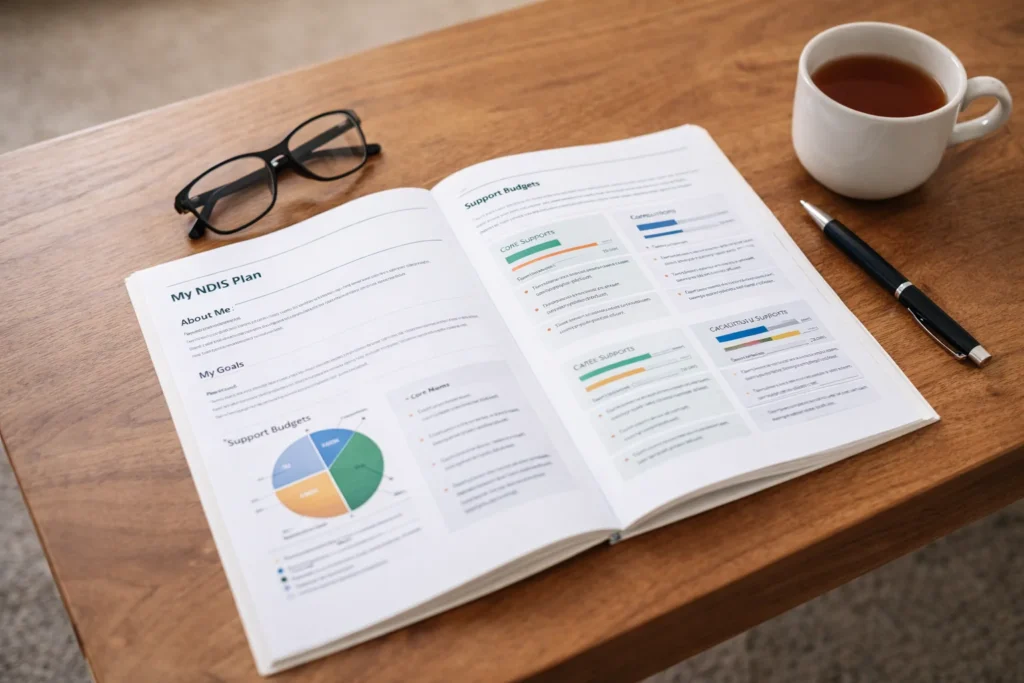
You will get a document once your planning meeting is over and your plan has been approved. It usually has 20 to 30 pages, but you don’t have to remember every one. There are three main parts of the plan that are most important to you.
1. Your Goals (The Plan’s “Heart”)
This is the most personal part of your plan. Your goals are what you care about. They don’t care what the NDIS wants; they care what you want for your life.
You can have big or small goals. They can be about anything that makes your life better, like work, school, health, or social connections. Your plan will make your goals clear, and everything you get will help you reach those goals.
Say hello to Sarah
Sarah is 34 years old and has a physical disability that she has had since she was born. She lives with her parents right now, but she wants to have her own place one day. This is what her NDIS plan’s goals might look like:
- “I want to learn how to cook my own meals safely so I can learn how to live on my own.”
- Goal 2: “I want to get stronger and more fit so I can do things on my own without needing my parents.”
- “I want to look into volunteer opportunities in my area to boost my confidence and meet new people.”
Do you see how these goals are clear, personal, and focused on what Sarah wants to do? Your goals should look exactly like that.
2. Your Budget and Supports (The “Money” Part)
This is where your money goes. The NDIS puts your money into three different “buckets” or groups. You should know that you can’t usually move money between these buckets without asking for a formal plan review. But you can often move money between subcategories within the Core Supports category.
| Name of the Bucket | What is it used for? | Example from Real Life (Sarah’s Plan) |
|---|---|---|
| Main Supports | This bucket can be used in the most ways. It includes the things you do every day and the help you need every day. | Consumables (04): Money for special cooking tools, non-slip mats, and tools that are easy to hold. Help with Daily Life (01): A support worker comes three times a week to help Sarah cook, clean, and shop for groceries. |
| Help with capital | This is for expensive things or equipment that you only need to buy once and that lasts a long time. | Assistive Technology (AT): Money for a special adaptive cutting board, a stool for the kitchen and a rolling trolley to safely move things. |
| Building Capacity | This is to help you learn skills and become more independent over time. Most of the time, this money goes to therapists and other experts. | Improved Daily Living (09): An occupational therapist goes to Sarah’s house to look at the kitchen layout, suggest safety changes, and show her how to cook safely. Better Health and Wellbeing (08): A physiotherapist helps Sarah get stronger in her upper body so she can safely lift pots, pans, and groceries. |
3. Your Plan Management (This is the “How You Pay” Part)
One of the most common questions new users ask is, “How do I pay for things?” This is what plan management is. You will choose one of three types of management when your plan is ready. This choice determines who pays your bills and which providers you can work with.
| Type of Management | How It Works | Who You Can Use |
|---|---|---|
| Managed by NDIA | Your providers get paid directly by the NDIS. You don’t touch the money at all. | You can only work with NDIS-registered providers. |
| Managed by oneself | You take care of the money yourself. You pay providers with your own money and then ask the NDIS for the money back. | You can use any provider, whether they are registered or not, which gives you the most freedom. |
| Managed by a plan | You hire a plan manager, who is a professional bookkeeper for NDIS funds. They take care of your budget, pay all of your bills, and handle all of your paperwork. | You can use any provider, whether they are registered or not, and you won’t have to worry about doing your own accounting. This is usually the best option for beginners. |
Common Questions for Beginners (Answered Honestly and Simply)
Let’s answer the questions that keep most beginners awake at night. These are the things that no one tells you right away, but you really need to know.
“What Does ‘Reasonable and Necessary’ Mean? What Do You Mean?
You will hear this phrase a lot. It is the main rule that the NDIS uses to decide what they will and won’t pay for. It just means that the NDIS will only pay for supports that meet all of these requirements:
- It makes sense for your situation and disability, so it’s reasonable.
- Necessary: You really need this help to live your life or reach your goals.
- Value for Money: The price of the support is about the same as the price of other similar supports.
- Not Covered by Other Systems: The NDIS doesn’t pay for things that Medicare, the education system, or other government services should pay for.
“What won’t the NDIS pay for?”
This is just as important as knowing what it pays for. The NDIS won’t pay for:
- Rent, mortgage payments, groceries, utility bills, and car registration are all costs of living every day.
- Help that isn’t related to your disability: For instance, if you want to go on vacation, the NDIS will pay for the support worker to go with you, but it won’t pay for your flights, hotel, or spending money.
- Things that other systems are in charge of include Medicare-covered medical care, school tuition, and equipment provided by the state health system.
“Is It Possible to Lose My Plan?”
The NDIS is designed to be ongoing for participants with permanent disabilities. You don’t “lose” your plan unless your circumstances change significantly (for example, if you no longer meet the disability requirements or if you move overseas). However, your plan is reviewed every 12 months. At that review, your funding might change based on your progress toward goals. If you have achieved a goal (like learning to cook), you may receive less funding in that area and more funding for a new goal (like seeking employment).
“Can I Choose Who Helps Me?”
Absolutely yes. This is one of the most empowering features of the NDIS. You are not locked into any specific company or provider. If you hire a support worker who doesn’t show up on time or a therapist you don’t connect with, you can find someone else. You are in control. This is why many participants choose plan management—it allows them to choose from the widest range of providers without being limited to NDIS-registered businesses.
Real-Life Example: A Full Day in the Life with an NDIS Plan
Sometimes, the best way to understand how all these pieces fit together is to see them in action. Let’s follow Tom, a 19-year-old man with autism, through a typical day using his NDIS plan.
Tom’s Goals:
- Build social connections and friendships outside of his family.
- Develop skills to gain and maintain a part-time job.
How Tom Uses His NDIS Plan Throughout the Day:
- 7:00 AM – Morning Routine (Core Supports – Assistance with Daily Life): Tom’s alarm goes off. He uses funding from his Core Supports budget to pay for a support worker to arrive at 7:00 AM. The support worker helps Tom organise his morning routine, prepare breakfast, and review his schedule for the day. They also practise public transport routes together, building Tom’s confidence to eventually do this alone.
- 10:00 AM – Job Interview (Capacity Building – Finding and Keeping a Job): Tom has a job interview at a local supermarket for a shelf-stacking position. Over the past month, Tom has been using his capacity-building funding to work with an employment support coach. This specialist practised interview questions with Tom, helped him prepare his resume, and accompanied him to the interview for moral support.
- 1:00 PM – Social Connection (Core Supports – Social and Community Participation): Tom meets a friend from his gaming group for lunch at a local café. He uses his Core Supports funding to pay for a support worker to drive him to the café and stay nearby. The support worker is present to help with ordering and to ensure Tom feels safe but steps back to allow Tom to interact independently with his friend.
- 4:00 PM – Therapy (Capacity Building – Improved Daily Living): Tom has a telehealth session with his psychologist, who helps him manage anxiety related to social situations and workplace stress. This is funded under his capacity-building budget.
- 7:00 PM – Relaxation (Capital Supports – Assistive Technology): After a busy day, Tom uses a pair of high-quality noise-cancelling headphones that he purchased with his Assistive Technology funding. They help him decompress and regulate his sensory environment after a day of high social demands.
Without the NDIS, Tom might be isolated at home, struggling to find work and navigate social situations alone. With the NDIS, he is actively building skills, pursuing employment, and forming meaningful connections.

Tips for Your First Plan: How to Get It Right
Your first NDIS plan sets the foundation for your entire journey. Getting it right from the start makes everything smoother. Here are four simple but powerful rules to follow.
1. Focus on Goals, Not Diagnosis
When you go to your planning meeting, it is natural to want to talk about your medical condition. But the NDIS planners don’t just want to hear about your diagnosis—they want to hear about your life.
- Don’t say: “I have a mobility impairment, and I need 10 hours of support per week.”
- Do say: “I want to be able to go to the gym three times a week to stay healthy and strong, but I can’t drive myself. I also want to visit my sister, who lives 20 minutes away, independently.”
When you frame your needs around goals, you give the planner a clear picture of what supports you require to achieve those goals. You are more likely to receive adequate funding this way.
2. Ask for a Plan Manager (Especially If You’re a Beginner)
If this is your first time navigating the NDIS, managing the money yourself can be stressful and time-consuming. In your planning meeting, specifically ask for “Plan Management” to be included in your plan.
A plan manager acts like a bookkeeper for your NDIS funds. They:
- Pay your invoices directly to your providers.
- Track your spending so you don’t accidentally run out of funds.
- Handle all the complex claiming processes with the NDIS portal.
- Give you the freedom to choose both registered and unregistered providers.
For a small fee (paid for by your plan), you get peace of mind and maximum flexibility.
3. Be Specific and Detailed
Vague goals lead to vague funding. The more specific you can be about what you want to achieve and how you want to get there, the better.
- Vague: “I want to be more independent.”
- Specific: “I want to learn how to use the public bus system to travel to my local shopping centre by myself within 6 months. I will need a travel trainer to accompany me for the first 3 months to teach me the route and bus timetables.”
A specific goal gives the planner clear information about exactly what kind of support you need (travel training) and how long you are likely to need it.
4. Bring Evidence to Your Planning Meeting
If you have reports from occupational therapists, physiotherapists, speech pathologists, or other specialists, bring them to your planning meeting. These reports can be incredibly helpful in demonstrating why you need specific supports. For example, a report from an OT that states “participant requires specialised seating to safely engage in community activities” is powerful evidence that should translate into funding for that equipment.
Understanding Your Funding: A Detailed Cheat Sheet
Once you receive your plan, you will see a table with support categories and dollar amounts. These categories can seem confusing at first. Here is a detailed cheat sheet to help you decode them.
| Support Category Code | Category Name | What It Pays For | Flexibility Level |
|---|---|---|---|
| 01_011_0106_1_1 | Assistance with Daily Life | Support workers for personal care (showering, dressing), household tasks (cleaning, laundry), and daily activities. | High (Core) – Flexible within the Core budget. |
| 03_025_0106_1_1 | Assistance with Social & Community Participation | Support workers to help you participate in social activities, recreational pursuits, or community events. | High (Core) – Flexible within the Core budget. |
| 04_104_0106_1_1 | Consumables | Everyday items like continence products, low-cost assistive technology, and special nutritional needs. | High (Core) – Flexible within the Core budget. |
| 07_039_0106_1_1 | Transport | Funding for travel costs if you cannot use public transport due to your disability. | Low – Usually locked to this category. |
| 08_038_0106_1_1 | Improved Health & Wellbeing | Physiotherapy, exercise physiology, dietetics, and other health-focused supports. | Medium (Capacity Building) – Usually locked to this category. |
| 09_008_0106_1_1 | Improved Daily Living | Occupational therapy, speech pathology, psychology, and other therapies focused on skill building. | Medium (Capacity Building) – Usually locked to this category. |
| 11_103_0106_1_1 | Plan Management | Funding to pay a plan manager to handle your invoices and budgeting. | Low – Pays the plan manager only. |

What Happens After You Receive Your Plan?
You’ve received your plan via email or post. Congratulations! Now comes the exciting part: putting it into action. Here is a simple checklist to guide you through your first few weeks.
Step 1: Read Your Plan Thoroughly
Take a few days to read your plan carefully. Don’t rush. Make sure:
- Your personal details are correct.
- Your goals accurately reflect what you discussed.
- The funding amounts look reasonable for your needs.
If you notice any mistakes or if the plan doesn’t reflect what you asked for, contact your planner or LAC immediately. It is much easier to correct errors early than to wait for your annual review.
Step 2: Decide on Plan Management
If you haven’t already, confirm how your plan will be managed. If you have Plan Management funding, now is the time to research and choose a Plan Manager. Look for one with good reviews, transparent fees, and a responsive customer service team.
Step 3: Find Your Providers
This is where you get to choose who supports you. You can:
- Ask friends, family, or local disability groups for recommendations.
- Search online directories of NDIS providers.
- Contact your Local Area Coordinator (LAC) for suggestions.
- Interview potential support workers or therapists to ensure they are a good fit for your personality and needs.
Step 4: Sign Service Agreements
Before any support begins, you should sign a service agreement with each provider. This is a simple contract that outlines:
- What services they will provide.
- How much they charge.
- How often they will bill.
- How to cancel or change the arrangement.
Keep copies of all service agreements in a folder for reference.
Step 5: Start Slowly and Build Confidence
You don’t need to use all your funding on day one. Start with one or two supports—perhaps a support worker for a few hours a week and one therapy session. Give yourself time to get comfortable with how the system works. As your confidence grows, you can add more supports.
Step 6: Keep Good Records
Create a system for tracking your spending. Whether you use a spreadsheet, a notebook, or an app, make sure you know:
- How much funding you have left in each category.
- Which invoices have been paid?
- When your plan review date is approaching.
Good record-keeping makes your annual plan review much smoother and helps you avoid accidentally overspending.
Conclusion: Your Journey Starts Today
It doesn’t have to be hard to understand your NDIS plan. At its most basic level, it’s a simple idea: a personalised set of supports to help you reach your goals in your own way, with the supports you choose.
Let’s recap the key takeaways:
- The NDIS is a national programme that helps Australians with permanent disabilities pay for reasonable and necessary support.The NDIS is a national system that provides funding for reasonable and necessary support for Australians with permanent disabilities.
- Your plan is a personal document that lists your goals and the money you have to reach them.
- Everything is driven by your goals. Be clear and focus on what matters to you.
- You are in charge. You pick your providers, how your plan is run, and how you reach your goals.
At first, it’s normal to feel confused. The NDIS is a big system, and no one thinks you can learn it all in one night. Move forward one step at a time. Ask questions. Contact support coordinators, local area coordinators, or other people who have gone through the process.It is completely normal to feel confused in the beginning. The NDIS is a big system, and no one expects you to master it overnight. Take it one step at a time. Ask questions. Reach out to support coordinators, local area coordinators, or other participants who have been through the process.
The most important thing to remember is that the NDIS is there to help people like you have better lives. You are now ready to start that journey with confidence because you have the right information.
Ready to Learn More? Your Next Steps
Understanding the NDIS is a step-by-step process. If you found this guide helpful, here are a few other resources that will help you continue your journey:
- What is NDIS in Australia? A Simple Beginner’s Guide 2026
- Who Is Eligible for NDIS? A Simple Beginner’s Guide for Australians 2026
- How to Apply for NDIS Step by Step: A Beginner’s Guide 2026
Disclaimer: This article is for informational purposes only and does not constitute legal or financial advice. NDIS policies and processes may change. Always refer to the official NDIS website or consult with a registered professional for advice specific to your situation.