
Contents
- 1 Introduction: Not Sure If You Qualify for NDIS?
- 2 A Quick Guide to the NDIS for NewbiesWhat Is the NDIS? (A Quick Overview for Beginners)
- 3 Who Can Get NDIS? The Three Most Important Things
- 4 Quick Look at NDIS Eligibility Requirements
- 5 What does it mean to have “substantially reduced functional capacity”?What does “substantially reduced functional capacity” mean?
- 6 Early Intervention: Are Kids Eligible for NDIS?
- 7 What kinds of disabilities does the NDIS not cover?
- 8 What kinds of help can people who are part of the NDIS get?
- 9 How do you sign up for the NDIS?
- 10 Frequently Asked Questions About NDIS Eligibility
- 11 Conclusion: Start Your NDIS Journey with Confidence
Introduction: Not Sure If You Qualify for NDIS?
Who is eligible for NDIS?” — it’s one of the most common questions Australians ask when they first hear about the National Disability Insurance Scheme. You might be wondering: Do I qualify? Is my disability ‘serious enough’? What if I am not sure what type of support I need?
You are not alone. Thousands of Australians feel the same confusion when they first learn about the NDIS. The good news is that the eligibility rules are clear once you understand them — and this guide will walk you through everything in plain English.
In this article, you will learn:
- Who can apply for NDIS funding
- What conditions and disabilities are covered
- The age and residency requirements
- How the NDIS decides if your disability is ‘significant enough’
- What early intervention support means and who it helps
- Real-life examples to help you understand how it all works
| Important: This article is for educational purposes only and is not legal or financial advice. Always consult an NDIS planner or Local Area Coordinator (LAC) for personalised guidance. |
A Quick Guide to the NDIS for NewbiesWhat Is the NDIS? (A Quick Overview for Beginners)
Before we talk about who can use the NDIS, let’s make sure you know what it is.
The National Disability Insurance Scheme (NDIS) is a programme in Australia that helps people with a permanent and severe disability by giving them money and support. The National Disability Insurance Agency (NDIA) is in charge of the NDIS.
If you have a disability that makes it hard for you to do things like get dressed, go to work, or talk to other people, the NDIS can help pay for the support you need.
This could include things like:
- A helper who comes to your house every day to help you with things.
- Therapy sessions, such as speech therapy or physiotherapy
- Specialised tools like a wheelchair or a hearing aid
- Changes to the home, such as grab rails or ramps
- Help with transportation to keep you safe on your trip

: Check out our guide on what the NDIS is and how it works.
Who Can Get NDIS? The Three Most Important Things
In general, you need to meet three main requirements to get help from the NDIS. Let’s go over each one clearly.
1. Age Limit
You have to be less than 65 years old when you first apply for the NDIS.
If you’re already over 65 and getting a disability, you might be able to get help through the My Aged Care system instead of the NDIS.
But if you were already a member of the NDIS before you turned 65, you can stay on the NDIS after that age.
| Maria is 58 years old and was just diagnosed with multiple sclerosis. She can apply for the NDIS because she is under 65. |
2. Requirement to Live There
You need to be an Australian citizen, have a permanent resident visa, or have a Protected Special Category Visa (which some New Zealand citizens living in Australia have).
You also need to be in Australia when you apply.
| For example, James moved from the UK to Australia ten years ago and now has permanent residency. He can apply for NDIS because he hurt his spinal cord. |
3. Requirement for Disability
This is the most important thing you need to do. To qualify, you must have a permanent and significant disability resulting from one of the following:
- A cognitive impairment (e.g., Down syndrome, intellectual disability)
- A cognitive impairment (e.g., acquired brain injury, dementia in younger individuals)
- A neurological disorder (e.g., multiple sclerosis, Parkinson’s disease, epilepsy)
- A sensory impairment (for example, being blind or deaf)
- A physical disability, such as a spinal cord injury or loss of a limb.
- A mental illness like schizophrenia or severe bipolar disorder
Let’s talk about what “permanent” and “significant” really mean:
Permanent: The disability is likely to last for the rest of your life or not get much better over time.
Important: The disability makes it much harder for you to do everyday things without help.
| Sophie has autism spectrum disorder (ASD), for example. Her condition is permanent and makes it hard for her to talk, handle sensory input, and join in on social activities. She meets the requirements for a disability. |
Quick Look at NDIS Eligibility Requirements
This table gives a quick overview of the main NDIS eligibility requirements in a way that is easy to read:
| Necessary | What it means | For example |
| How old | Must be under 65 when you first apply | Sarah is 42 years old and has a permanent disability. She can apply. |
| Living in | You must be an Australian citizen, permanent resident, or holder of a Protected Special Category Visa. | Tom lives in Melbourne and has a permanent visa that lets him stay there. |
| Disability | Must have a permanent and serious disability caused by a neurological, sensory, physical, cognitive, intellectual, or psychiatric problem. | Lisa has had cerebral palsy since birth, which means it is permanent. |
| Effect on Daily Life | The disability must significantly diminish the capacity to engage in daily activities. | Jake needs help getting dressed, making meals, and getting to work. |
| Intervention Early | Children or individuals who would gain from early assistance prior to the confirmation of a formal diagnosis. | A 3-year-old exhibiting substantial developmental delays may be eligible. |
🔗 Find out more: Full Guide to NDIS Eligibility Requirements
What does it mean to have “substantially reduced functional capacity”?What does “substantially reduced functional capacity” mean?
People who talk about NDIS a lot will use the phrase “substantially reduced functional capacity.” This may be hard to understand, but it just means that your disability makes it much harder for you to do things that most people can do on their own.
The NDIA looks at six parts of your daily life to see how well you can function:
- Communication: Are you able to talk, read, write, or understand other people on your own?
- Social skills: Can you make and keep friends?
- Learning—Are you able to learn new things and skills?
- Mobility—Can you get around on your own?
- Self-care: Can you take care of your own food, clothes, and hygiene?
- Self-management: Can you look after your own health, safety, and daily chores?
If your disability has a big effect on two or more of these areas, you probably meet the functional capacity requirement for NDIS eligibility.
| For example, Daniel has a very bad intellectual disability. He has trouble saying what he needs, needs help with personal care every morning, and can’t travel alone safely. His disability makes it hard for him to talk to people, take care of himself, and move around, which makes him eligible for the NDIS. |

Early Intervention: Are Kids Eligible for NDIS?
Yes, kids can also get help from the NDIS, and in many cases, early intervention support is very important.
The NDIS has a special programme for kids under 9 years old called Early Childhood Early Intervention (ECEI). Starting in July 2023, this programme will be open to kids under 7 years old as well. The NDIA is still making changes to the age requirements, so check with them for the most up-to-date information.
Who Can Get Help with Early Intervention?
Kids who have a developmental delay or disability that is likely to get better with early help may be able to get help. This includes:
- ASD, or autism spectrum disorder
- Delay in global development
- Delays in speech and language
- Hearing or sensory problems
- Cerebral palsy
- Syndrome of Down
Early intervention does not necessitate a definitive diagnosis. In some cases, a child with serious developmental delays can start getting help while tests are still going on.
| For example, Liam is four years old. His parents are worried about how well he talks and gets along with others. A paediatrician has observed considerable delays. Liam can get help as soon as possible through the NDIS, even if he hasn’t been formally diagnosed with autism yet. |
🔗 Read more about how the NDIS helps kids with disabilities in Australia.
What kinds of disabilities does the NDIS not cover?
Knowing what the NDIS doesn’t cover is just as important. The NDIS is not meant to help with every health problem.
Conditions that are not usually eligible for NDIS include:
- Injuries that will heal, like a broken leg
- Chronic health conditions effectively managed through medical intervention that do not substantially hinder daily functioning (e.g., well-regulated asthma or diabetes).
- Conditions that are mostly caused by getting older (My Aged Care covers these for people 65 and older)
- Mental health conditions that are episodic and do not result in a permanent, substantial impairment
| Please be aware that mental health conditions can be eligible for the NDIS if they are permanent and make it hard to do everyday tasks. For instance, severe schizophrenia that doesn’t respond to treatment may qualify, but mild depression that does respond to treatment probably wouldn’t. |
What kinds of help can people who are part of the NDIS get?
Once you are accepted into the NDIS, you will get a personalised NDIS plan. This plan tells you how much money you will get and what kinds of help you can get.
Here is a list of the main types of NDIS support:
| Category of Support | What It Talks About | Example from Real Life |
| Things to do every day | Help with getting dressed, taking care of yourself, and making meals | Every morning, a support worker helps John take a shower and make breakfast. |
| Building Capacity | Therapy, learning new skills, and becoming more independent | NDIS pays for Emma’s speech therapy sessions. |
| Community and social | Taking part in community events, social activities, and hobbies | Michael becomes a member of a supported social group at the community centre near him. |
| Getting around | Help with getting to appointments, work, or social events | Priya uses NDIS money to pay for transport that is easy for her to use to get to her medical appointments. |
| Changes to the Home | Changes to the home for safety or ease of access | David’s bathroom and entrance have grab rails and ramps. |
| Technology that helps | Tools that help people be more independent, like wheelchairs and hearing aids | Grace gets a custom-made power wheelchair through her NDIS plan. |
🔗 Find out what NDIS funding pays for. A Beginner’s Guide to the Different Types of NDIS Support
How do you sign up for the NDIS?
Here’s a quick overview of how the NDIS works if you or someone you care about might be able to get it:
Step 1: Make sure you meet the basic requirements.
You can either use the NDIS eligibility checklist or talk to a Local Area Coordinator (LAC) in your area. You can also call the NDIS at 1800 800 110.
Step 2: Collect Evidence to Back Up Your Claim
You will need paperwork from a doctor, specialist, or therapist that explains your disability, how long it will last, and how it affects your daily life.
Step 3: Send in a request for access
You or someone else can send an Access Request to the NDIA. You can do this over the phone, in person, or online.
Step 4: The NDIA looks over your application.
The NDIA will look over your proof and decide if you qualify. It can take a few weeks for this to happen.
Step 5: Meeting to Plan
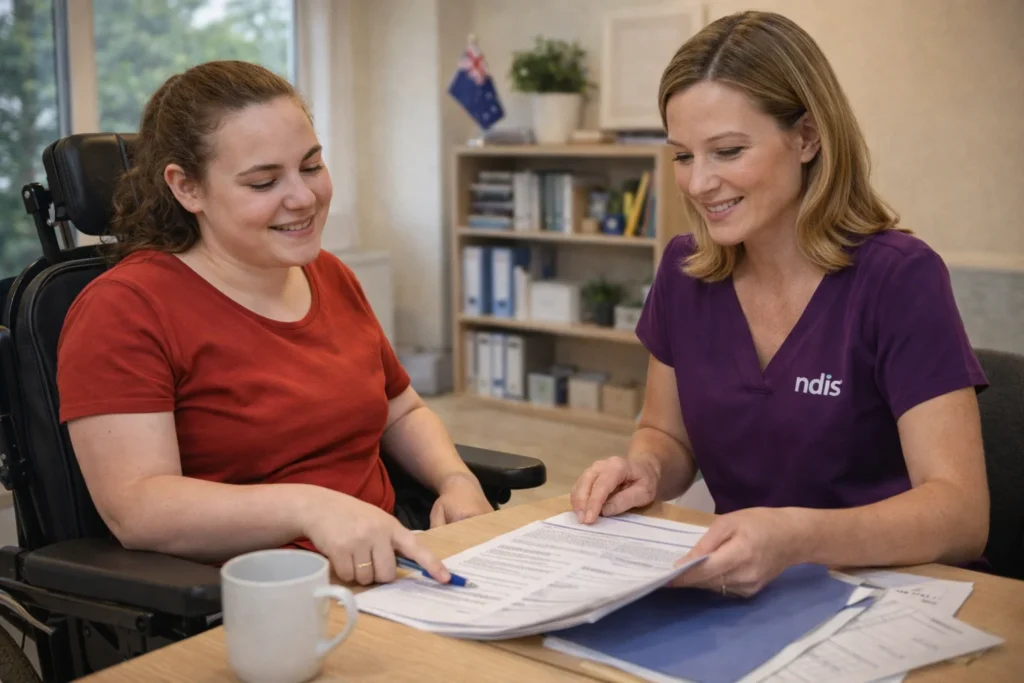
If your request is approved, you will have a planning meeting to talk about your needs, goals, and the help you need. This is how your personalised NDIS plan comes to be.
🔗 Read our guide on how to apply for NDIS, which has all the information you need.
Frequently Asked Questions About NDIS Eligibility
If I have a mental health problem, can I still apply for NDIS?
Yes, you can, but your mental health condition must be permanent and make it hard for you to do things you used to be able to do. It is possible that episodic conditions that respond well to treatment do not meet the criteria. The best way to get more evidence is to talk to your psychiatrist or GP.
What if I’m not sure if my disability is “permanent”?
You don’t have to figure out what’s wrong with yourself. A doctor, psychologist, or other medical professional can write you a letter or report that explains what your disability is and how it will affect you in the long term. The NDIA will use this proof to make their decision.
Can I help someone else apply for NDIS?
Yes. Someone who can’t apply for themselves, like a child or someone with a severe intellectual disability, can have a parent, guardian, carer, or authorised representative apply for them.
What will happen if my application is turned down?
You can ask for a review of the NDIA’s decision if they say you are not eligible. You can also talk to an NDIS advocate to help you understand your options and reapply with better evidence.
Is NDIS the same as Medicare or Centrelink?
No. The NDIS is separate from Medicare and Centrelink. Medicare covers health and medical services. Centrelink provides income support payments. The NDIS specifically funds disability-related supports and services to help you live more independently.
Conclusion: Start Your NDIS Journey with Confidence
Understanding NDIS eligibility does not have to feel overwhelming. Let’s recap what you have learned in this guide:
- The NDIS is Australia’s national disability support scheme, funded by the government
- To be eligible, you must be under 65, an Australian resident, and have a permanent and significant disability
- Your disability must substantially reduce your ability to carry out daily activities
- Children under 9 (and in some cases younger) may access early intervention supports
- Not all conditions qualify — the disability must be permanent and significantly impact daily life
- The application process involves an Access Request, supporting evidence, and a planning meeting
Every person’s situation is unique. If you are unsure whether you or a loved one qualifies, the best first step is to speak with a Local Area Coordinator (LAC), reach out to the NDIA directly, or connect with an NDIS support organisation near you.
You deserve the right support. Understanding your eligibility is the first step towards getting it.
| Take the first step today: Call the NDIS on 1800 800 110 or visit ndis.gov.au to find out more about your eligibility and options. |
🔗 Learn more: How to Apply for NDIS — Step-by-Step Guide
🔗 Start understanding your options: NDIS Eligibility Requirements Explained
🔗 Explore: What Can NDIS Fund? A Complete List of Supports and Services
Disclaimer
This article is for educational and informational purposes only and does not constitute legal, financial, or professional advice. NDIS rules and eligibility criteria may change. Always consult with an NDIS planner, Local Area Coordinator (LAC), or a registered NDIS support organisation for advice specific to your situation. NDISInsider.com does not represent or work for the NDIA.